Why are period cramps worse at night? (And what to actually do about it)
You've made it through the day — and then night-time cramps hit. There's a physiological reason this happens. Here's what's going on and how to deal with it.
You've dragged yourself through a painful day, you finally lie down to sleep, and then — somehow — it gets worse.
Night-time period cramps are not your imagination. There are real physiological reasons why cramping can intensify after dark, and they're not all the same for everyone. The good news: once you understand what's driving it, you can actually address it.
Why cramps feel worse at night: the main reasons
1. Pain is relatively louder when distractions disappear
This is the most common reason, and it's not psychological weakness — it's basic neuroscience.
During the day, your brain receives constant competing inputs: work tasks, conversations, screen stimulation, physical movement. These inputs compete for attention in the somatosensory cortex, which essentially means there's less bandwidth available to register pain signals.
When you lie down in the dark and the inputs disappear, pain that was there all day but partially masked by distraction suddenly becomes the loudest thing in the room. This is the same reason toothaches and headaches feel worse at night — the silence amplifies them.
What this means: your cramps aren't actually worse — your awareness of them is. That said, it still makes sleep impossible, so the cause doesn't change the problem.
2. Lying flat changes uterine positioning
When you're upright during the day, the uterus sits in a position that allows menstrual blood to flow downward by gravity. When you lie flat, that gravity assist disappears — blood can pool in the uterus, pressure increases, and cramping can intensify as the uterus works harder to expel the lining.
This is particularly noticeable for people with a retroverted uterus (tilted backwards — affects roughly 25% of women), where certain lying positions put more pressure on surrounding structures.
What helps: sleeping in the foetal position (on your side, knees drawn up) is better than lying flat on your back. It takes pressure off the uterus and can meaningfully reduce cramping. A pillow between your knees helps maintain this position.
3. Prostaglandin levels and the sleep-wake cycle
Prostaglandins — the hormone-like chemicals that cause uterine contractions and cramping — are not produced at a flat rate across the day. Research suggests their production is partly influenced by cortisol levels and the circadian rhythm.
Cortisol (your stress/alertness hormone) is naturally lower at night. Since prostaglandins and cortisol have a complex relationship with the inflammatory response, reduced cortisol at night can mean more unopposed prostaglandin activity — which translates to more intense cramping.
This is the same mechanism that makes inflammatory conditions like arthritis and chronic pain often worse in the early morning hours.
4. Your NSAID dose has worn off
If you took ibuprofen in the morning and early afternoon, there's a reasonable chance the last dose has metabolised by the time you try to sleep. Standard ibuprofen lasts 4–6 hours. Naproxen lasts 8–12 hours.
For many people, night-time cramps are simply a coverage gap — the medicine that was managing pain during the day has worn off.
What helps: take a dose of naproxen (or ibuprofen) with your evening meal on heavy pain days. Naproxen's longer half-life makes it better suited to overnight coverage than ibuprofen. Always with food.
5. Tension and sleep position build on existing pain
When you're uncomfortable and in pain, you tense your muscles involuntarily — particularly the lower back and abdomen. This tension is counterproductive: it makes cramping worse by adding muscular spasm on top of uterine cramps.
A day of sitting at a desk in a tense, cramped position also leaves the lower back and hip flexors shortened and tight — which compounds evening and night-time pelvic pain.
What helps: gentle stretching before bed, particularly hip flexors and lower back, can reduce the muscular component of night-time cramping significantly.
What to do about night-time period cramps
Use TENS before bed
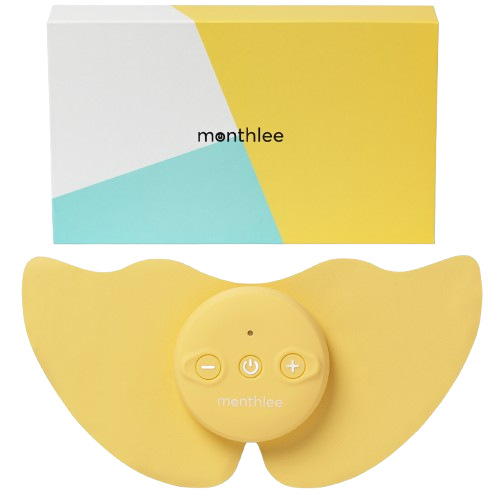
A wearable TENS device is one of the most effective tools for night-time cramps because it works without drugs, without side effects that affect sleep, and can run continuously while you're resting.
Emmeline can be worn in bed — put her on 20–30 minutes before you want to sleep, set an intensity that gives relief without being distracting, and let the continuous electrical stimulation interrupt the pain signal while you drift off. Many users run Emmeline through the night on lower settings with no issues.
Unlike heat patches (which can get uncomfortably hot during the night and shouldn't technically be slept with) or ibuprofen (which you can't redose every 2 hours), TENS is safe to run continuously for as long as needed.
Cover yourself with naproxen overnight
If you're taking NSAIDs, switch to naproxen for evenings. Take 250–500mg with dinner on the first two nights of your period. Naproxen's 8–12 hour half-life means it'll still be working when you'd otherwise be woken up at 2am.
Ibuprofen is fine during the day, but it simply doesn't last long enough for overnight pain coverage.
Sleep on your side in foetal position
Draw your knees up, use a pillow between your legs, and avoid lying flat on your back. This reduces uterine pressure, takes the strain off the lower back, and is consistently reported as the most comfortable position for period pain.
Heat patch (if appropriate)
A low-temperature adhesive heat patch applied before bed can help with the muscular tension component of night-time pain. However, don't use heat patches while sleeping if they generate significant heat — there's a low but real risk of skin irritation or mild burns during extended sleep contact. Lower-temperature patches designed for extended wear are safer.
Simple pre-bed stretches
Five minutes before bed — not a full yoga session, just:
- Child's pose: 60 seconds — releases lumbar and sacral tension
- Supine knees-to-chest: 60 seconds each side — decompresses the lower back and gently mobilises the pelvis
- Cat-cow: 8–10 repetitions — mobilises the spine and relaxes the pelvic floor
These take less than 5 minutes and consistently reduce the muscular tension that amplifies cramping when you lie down.
When night-time cramps are severe enough to see a doctor
If your night-time period pain is:
- Regularly waking you from sleep, multiple nights per cycle
- Unresponsive to NSAIDs and TENS combined
- Getting worse over time, not staying stable
- Accompanied by pain during sex, painful bowel movements, or pelvic pain throughout the month
These patterns are more consistent with an underlying condition — endometriosis, adenomyosis, or fibroids — than with typical primary dysmenorrhea. These conditions are common, diagnosable, and treatable. See your GP (UK) or OB-GYN (US) and ask specifically about them.
The bottom line
Night-time cramping is worse for real reasons — not because you're somehow weaker after dark. Address the coverage gap with naproxen in the evening, use TENS before and during sleep, get into a foetal position, and stretch before bed.
Most people who try this combination report significantly better nights — not perfect, but manageable enough to actually sleep.
TENS that works while you sleep
Emmeline is a wearable TENS device for period pain — designed to work discreetly under clothing and in bed. Silent, wireless, up to 10 hours battery. Put her on before sleep and let her do the work.
Shop Emmeline → — 20 intensity levels. Free shipping. 60-day money-back guarantee.
keep reading
- →Period pain relief
How to help someone with period pain: what to do, what to say, and what to buy
Watching someone you love curl up with period pain and not knowing what to do is hard. Here is what the NHS suggests, what to say, what to leave unsaid, and how to know when it is time to push for a doctor.
- →TENS
Is TENS safe for period pain? Who shouldn't use it, and what to check first
For most people with ordinary period cramps, a TENS device is a low-risk option, but a few groups should not use one without medical advice. Here is who they are, where the pads must never go, and what the research says about side effects.
- →TENS
How long can you use a TENS machine for period pain? (And the settings that actually matter)
There is no daily dose limit on a TENS machine the way there is with painkillers. Here is how long a session should run, how often you can use it across your period, whether you can leave it on all day, and the two settings that decide whether it works.