Tensie or Emmeline? A straight comparison of two no-heat period TENS devices
Tensie is a new, cheaper wearable TENS device for period cramps. Emmeline is ours. Both skip heat and sell on Amazon — here is a straight comparison of shape, pads, price, battery and returns, including what Tensie does better.
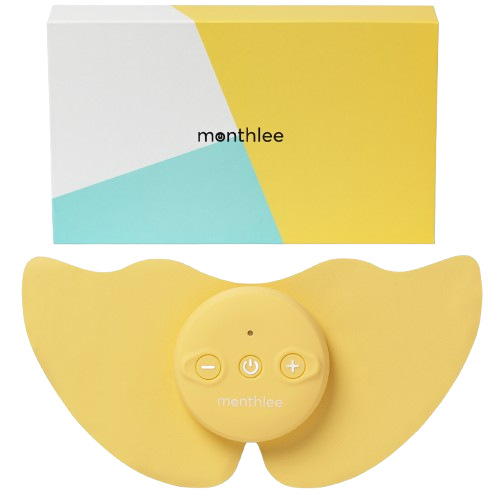
Short answer: Tensie and Emmeline are both drug-free, no-heat wearable TENS devices for period cramps, sold on Amazon and direct to customers. They are close on price — Tensie is around $45 on its own site, Emmeline is $49.99 — and they use the same mechanism: a mild electrical pulse that interrupts the cramp signal before it reaches your brain. The two real differences are shape and returns. Emmeline is fully wireless, so the control unit clips straight onto the pad stuck to your skin. Tensie is not — a cable runs from its pads to a control box that clips to your waistband. And Emmeline's 60-day money-back guarantee covers a device you have used and decided against, while Tensie's published returns policy asks for items "new, unused" and "sealed in the original packaging". Neither device is a cure for anything.
If you have both sites open tonight and a cramp that is not waiting, here is the version that respects your time. These are two similar devices at a similar price. Choose on the two things that actually differ: whether you mind a wire and a waistband clip, and how much it matters that you can send the device back after trying it. Everything else is close.
First, the obvious bias
Emmeline is ours. Our name is on the box and we would like you to buy it. So treat this as an interested comparison and read Tensie's own site before you decide — every figure below was checked in September 2026, and prices and specs move.
What we are not going to do is tell you Tensie is a bad product. It is a new device from a women's health company called TINA Healthcare, whose main product is a tampon-insertion aid (TINA Healthcare). Tensie is drug-free, rechargeable, and sits on the same shelf as Emmeline. Where it beats us, we say so.
How the two are the same
Both are wearable TENS units built for period pain. Both:
- stick to your lower abdomen, or your lower back, with replaceable gel pads
- run off a small rechargeable controller and charge over USB-C in about two hours
- skip heat entirely — neither has a warming function
- are drug-free, and are pain relief only, not a treatment for endometriosis, adenomyosis or any underlying condition
- sell on Amazon US and on the brand's own website
What the evidence says. Both use high-frequency TENS. A 2024 Cochrane review found it reduces the intensity of primary dysmenorrhea — ordinary period cramps — compared with placebo or no treatment, across multiple trials (Cochrane, Han et al. 2024). That evidence belongs to the method, not to either brand. Neither Tensie nor Emmeline has its own published trial, and how well TENS works varies a lot from person to person — which is exactly why being able to return the device matters, and we come back to that below. We describe TENS as clinically studied for period pain, and we are careful not to promise more than that.
The comparison
| Tensie | Emmeline | |
|---|---|---|
| Price (device) | around $45 (tinahealthcare.com) | $49.99 (RRP $69.99) |
| Fully wireless? | No — a cable runs from the pads to a waistband-clip control box (how to use Tensie) | Yes — the control unit clips onto the pad on your skin |
| Heat | No | No |
| Intensity | 30 levels (Amazon listing) | 20 levels across 6 pulse patterns |
| Battery per charge | Around 10 hours (their setup guide and Amazon listing; one page on their site says 8) | 5–10 hours |
| Charge time | About 2 hours, USB-C | About 2 hours, USB-C |
| Replacement pads | Flower-shaped electrode pads, $15 per 2-pack, up to 80 uses each (tinahealthcare.com) | "Angel wings", $11.99 per 2-pack, less per pack by the 3-pack, up to 30 uses each |
| In the box | Control unit, waistband clip, Y-cable, electrode pads, spare gel pads, charger, travel bag | Device, angel wings, USB-C charger, manual, storage pouch |
| Reviews | Too new for a settled review base | 4.5★ / about 40 on Amazon US |
| Returns | 60 days, but "new, unused" and "sealed in original packaging"; used devices non-returnable; buyer pays return shipping (refund policy) | 60-day money-back guarantee covering a device you have used |
What Tensie does better than Emmeline
It costs a little less up front. Tensie is around $45 on its own site, which prices in US dollars and adds shipping at checkout for UK and other overseas buyers. Emmeline is $49.99. On the day you buy, Tensie is the cheaper ticket — though see the running-cost section, because the device price is not the whole cost.
More intensity steps. Tensie has 30 levels to Emmeline's 20. Most people find one setting that works and leave it there, so this matters less in practice than it looks on a spec sheet. But if you like fine control, Tensie gives you more increments. Emmeline's answer to this is 6 distinct pulse patterns rather than more steps on a single one.
Pads that are cheaper to run. This is the one that adds up. On the figures each brand publishes, a $15 pair of Tensie pads covers up to 160 uses between them; a $11.99 pair of angel wings covers up to 60. Pad-life numbers are a ceiling, not a promise — how long a gel pad lasts depends on your skin, how you store it and how often you clean it — but even if you halve both figures, Tensie's pads cost less per cycle. If you use a wearable every month, that gap compounds over a year.
It ships to more countries. Tensie lists shipping to the US, UK, Canada, France, Germany, Ireland and several others (tinahealthcare.com). If you are outside the US or UK, Emmeline may not reach you yet and Tensie might.
What Emmeline does better than Tensie
It is actually wireless. This is the big one. With Emmeline, the control unit snaps directly onto the angel wing that is stuck to your skin. There is no wire, and nothing clipped to your waistband — it sits flat under a dress and you forget it is there. Tensie runs a Y-cable from its pads to a control box, and that box clips to your waistband (how to use Tensie). That is a more conventional TENS layout, and for some people it is fine. But if discretion is the reason you want a wearable in the first place, a wire and a belt clip is a real step down from a single pod on your skin.
You can try it and send it back. Emmeline's 60-day money-back guarantee is there precisely because TENS does not work for everyone. Tensie's returns policy, as published, asks for items "new, unused" and "sealed in the original packaging", and lists used devices as non-returnable (TINA Healthcare refund policy). Read plainly, that means you cannot open a Tensie, use it for a cycle, and return it if it did nothing for you. For a device whose honest pitch is "this helps a lot of people, and nobody can tell in advance whether you are one of them", that is the difference that would decide it for us.
A track record, small as it is. Emmeline has around 40 reviews on Amazon US at 4.5 stars (Amazon). That is not a large sample, and we would rather say so than dress it up. But Tensie is new enough that there is no settled body of independent reviews to read yet. Forty honest reviews beats none.
Running cost over a year
The device is a one-off. Pads are the forever cost. If you use a wearable every cycle, budget for a fresh pair of pads every couple of months with either brand.
- Tensie: around $45 for the device, then pads at $15 a pair, up to 80 uses each.
- Emmeline: $49.99 for the device, then angel wings at $11.99 a pair — cheaper by the 3-pack — up to 30 uses each.
On published numbers, Tensie is a little cheaper to own over a year. Emmeline's case is not that it is the cheapest — it is that it is genuinely wireless and genuinely returnable, and that those two things are worth the difference.
Who should buy which
Buy Tensie if the lowest running cost matters most to you, you do not mind a wire and a waistband clip, and you are comfortable buying a device you cannot return once it is opened.
Buy Emmeline if you want a genuinely wireless pod with nothing clipped to you, and you want the option to try it for a cycle and send it back if it does not help.
Buy neither yet, and book a doctor's appointment, if your period pain is severe, getting worse, or stopping you living your life. Both devices manage pain. Neither investigates why it is there, and severe period pain can be a sign of endometriosis, adenomyosis, fibroids or PCOS — those need a diagnosis, not a gadget. Use a device if it helps, and get the appointment.
Safety, for either device
Do not use any TENS device if you have a pacemaker or another implanted electronic device, if you are pregnant, or if you have epilepsy, without speaking to your doctor first. Do not place the pads over broken skin, the front of your neck, or your chest. Do not sleep wearing one.
FAQ
Is Tensie or Emmeline better for period pain? Neither is clearly better at relieving pain — they use the same high-frequency TENS mechanism. Tensie is a little cheaper up front and its pads cost less per use. Emmeline is fully wireless with no cable or waistband clip, and its 60-day guarantee lets you return the device after using it, which Tensie's returns policy does not.
Why is Emmeline wireless and Tensie is not? Emmeline's control unit clips straight onto the gel pad on your skin, so there is nothing else to wear. Tensie uses a Y-cable between the pads and a separate control box that clips to your waistband (how to use Tensie). Both deliver TENS; the difference is how much you are wearing and how visible it is under clothes.
Can I return Tensie if it does not work for me? Based on TINA Healthcare's published refund policy, no — returns require items "new, unused" and "sealed in the original packaging", and used devices are listed as non-returnable (refund policy). Emmeline's 60-day money-back guarantee is designed to cover a device you have used. Check both policies yourself before buying, as terms change.
Are Tensie's pads really cheaper? On the numbers each brand publishes, yes. A $15 pair of Tensie pads is rated for up to 80 uses each; a $11.99 pair of angel wings for up to 30. Treat those as best-case figures — real pad life depends on your skin and how you store them — but Tensie's pads still work out cheaper per cycle.
Does either one use heat? No. Both are TENS-only. If you specifically want heat, neither is the right pick — we explain why we left heat out of Emmeline in a separate post.
Do these devices work on endometriosis itself? No. Both provide pain relief only. Endometriosis has no cure, and neither device changes the underlying condition. Use one to manage the pain while you get, and act on, a proper diagnosis.
The one we sell
Emmeline is a wireless TENS device for period pain. It clips onto our angel wings — soft wing-shaped pads that stick where it hurts and hold there — sits flat under your clothes with no wire, and works in minutes.
Meet Emmeline → — $49.99, 20 intensity levels across 6 pulse patterns, 5–10 hours per charge, free shipping, 60-day money-back guarantee.
keep reading
- →Period pain relief
How to help someone with period pain: what to do, what to say, and what to buy
Watching someone you love curl up with period pain and not knowing what to do is hard. Here is what the NHS suggests, what to say, what to leave unsaid, and how to know when it is time to push for a doctor.
- →TENS
Is TENS safe for period pain? Who shouldn't use it, and what to check first
For most people with ordinary period cramps, a TENS device is a low-risk option, but a few groups should not use one without medical advice. Here is who they are, where the pads must never go, and what the research says about side effects.
- →Generic TENS
Emmeline or a generic TENS unit? An honest answer to “is a period TENS just a pink tax?”
A generic TENS unit uses the same technology as a period TENS device and costs less. It also gives you more settings. Emmeline is ours, and what you pay extra for is wearability: no wires, no belt clip, and a battery that lasts a working day. Here's where each one wins, and how to set up a generic if you go that way.