Pixie or Emmeline? A straight comparison of two wearable TENS devices for period pain
Pixie Pulse markets itself on being thin and unnoticeable under clothes. Emmeline is ours, and is genuinely wireless. Here is a straight comparison of price, battery, pads, returns and what 'discreet' actually means for each device.
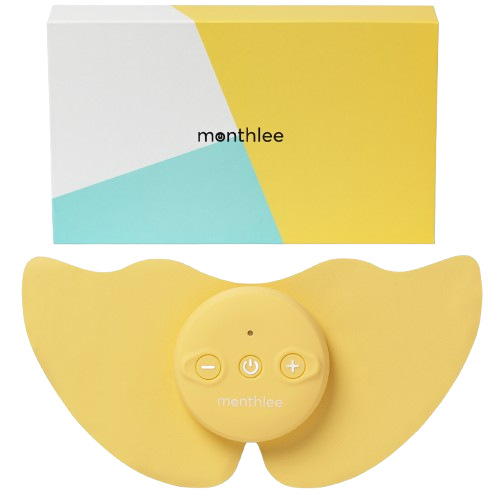
Short answer: Pixie Pulse and Emmeline are both drug-free wearable TENS devices for period cramps, sold on Amazon and direct to customers, and both are marketed on discretion. Pixie is $87 at list price (often discounted to around $61) with a 100-day money-back guarantee; Emmeline is $49.99 with a 60-day guarantee. The real difference is what "discreet" means in practice. Pixie's control unit sits on a cable, clipped to your waistband, connected to the pads by a wire. Emmeline's control unit clips straight onto the pad on your skin — no wire, nothing on your waistband. Pixie has more than double the guarantee window; Emmeline's pads last roughly three times as long. Neither device is a cure for anything.
If you're comparing these two tonight, here's the version that respects your time. Pixie wins on returns and running you can try; Emmeline wins on actually being wireless and on pads that last longer between replacements. Read on for the numbers behind both claims.
First, the obvious bias
Emmeline is ours. Our name is on the box and we'd like you to buy it. So treat this as an interested comparison, and check Pixie's own site before you decide — every figure below was checked in September 2026, and prices and specs move, especially on a device that appears to run frequent sales.
Pixie Pulse is made by Pixie Cup, a women's health company better known for menstrual cups (itspixie.com). It is a real, established device — it has been selling on Amazon since at least mid-2026 — not a new entrant like some of the devices we've compared Emmeline against. Where it beats us, we say so.
How the two are the same
Both are wearable TENS units built for period pain. Both:
- stick to your lower abdomen or lower back with gel pads
- run off a small rechargeable controller, USB charged
- are marketed specifically on being discreet enough to wear under clothes
- are drug-free, and are pain relief only — not a treatment for endometriosis, adenomyosis or any underlying condition
- sell on Amazon US and on the brand's own website
What the evidence says. Both use high-frequency TENS. A 2024 Cochrane review found it reduces the intensity of primary dysmenorrhea — ordinary period cramps — compared with placebo or no treatment, across multiple trials (Cochrane, Han et al. 2024). That evidence belongs to the method, not to either brand. Pixie's own marketing says the device "works better than strong painkillers" — we can't verify that claim and won't repeat it as fact. We describe TENS as clinically studied for period pain, not proven, because how well it works varies a lot from person to person.
The comparison
| Pixie Pulse | Emmeline | |
|---|---|---|
| Price (device) | $87 list, often on sale around $61 (itspixie.com) | $49.99 (RRP $69.99) |
| Fully wireless? | No — a Y-cable runs from the pads to a control unit that clips to your waistband, with an extended cable in the box (itspixie.com) | Yes — the control unit clips onto the pad on your skin |
| Heat | No | No |
| Intensity | 40 levels, constant or intermittent pulse pattern (2 modes) (itspixie.com) | 20 levels across 6 pulse patterns |
| Battery per charge | Around 12 hours (itspixie.com) | 5–10 hours |
| Charge time | About 1 hour 30 minutes | About 2 hours, USB-C |
| Replacement pads | Gel pads, roughly 8–10 uses each before replacement (itspixie.com) | "Angel wings", $11.99 per 2-pack, less per pack by the 3-pack, up to 30 uses each |
| In the box | Control unit, Y-cable, extended Y-cable, pouch, USB charger, pad storage disc, pulse pads, 4 replacement gel pads, manual | Device, angel wings, USB-C charger, manual, storage pouch |
| Warranty / returns | 2-year warranty; 100-day money-back guarantee (itspixie.com) | 60-day money-back guarantee |
| Reviews | Amazon listing has been live since at least mid-2026; we couldn't pull a current, verified star rating for this piece | 4.5★ / about 40 on Amazon US |
What Pixie does better than Emmeline
A much longer window to decide. 100 days is more than three menstrual cycles for most people — enough to try the device through a few periods and know for certain whether TENS helps you, not just guess from one cycle. Emmeline's 60-day guarantee covers roughly two cycles. If you're the kind of buyer who wants maximum room to be sure before committing, this is a real point in Pixie's favour.
More intensity steps, and two pulse patterns. 40 levels against Emmeline's 20, plus a choice between constant and intermittent pulse. Most people land on one setting and stay there, so this matters less day-to-day than it looks on a spec sheet — but if you like to fine-tune, Pixie gives you more room to do it.
Slightly longer battery life on paper. Around 12 hours against Emmeline's 5–10, though real-world battery life on any TENS device depends heavily on intensity level and how much you run it, so treat both figures as best-case.
A 2-year warranty against manufacturing faults, which is a separate thing from the money-back guarantee and something Emmeline doesn't publish a figure for.
What Emmeline does better than Pixie
It's actually wireless. This is the one that matters most given how both brands market themselves. Pixie's own copy calls it "the thinnest wearable TENS unit" and "unnoticeable under clothes" — but the device itself has a Y-cable running from the pads to a control unit, which then clips to your waistband. That's a cable and a clip you're wearing, even if the control box itself is small. Emmeline's control unit clips directly onto the angel wing stuck to your skin. There's no cable, nothing on your waistband — it sits flat under a dress and you forget it's there. If discretion is genuinely why you want one of these, the difference between "a small clipped-on box with a wire" and "nothing but the pad" is the difference that actually delivers on the promise.
Pads that last three times as long. Pixie's gel pads are rated for roughly 8–10 uses before you need fresh ones. Emmeline's angel wings are rated for up to 30. If you use a device every cycle, that's the difference between replacing pads every one to two periods and every five or six. Over a year, that gap compounds in both cost and how often you have to remember to reorder.
A track record we can actually show you. Emmeline has around 40 reviews on Amazon US at 4.5 stars (Amazon). That's a modest sample and we'd rather say so than dress it up — but we could verify it today. Pixie's listing has been live for longer than ours, and its own site doesn't publish a current review count, so we're not going to guess a number for a competitor's product.
The "discreet" claim, checked properly
Both brands sell on the same promise: nobody needs to know you're wearing this. It's worth being precise about what that promise actually requires, because the two devices deliver it differently.
Pixie's marketing leans hard on size — "size of a thumb drive," small and light. That's true of the control unit itself. But a TENS device isn't just the control unit; it's the control unit plus however it connects to the pads on your skin. Pixie's control box clips to a waistband and is joined to the pads by a wire, per its own product listing. Under looser clothing that's genuinely unnoticeable. Under something fitted, a clip and a cable line are things a hand resting on your hip could find.
Emmeline skips the question entirely by not having a separate control unit to clip anywhere — it's one pod, on the pad, on your skin. That's a structural difference in how the two devices are built, not a marketing difference in how they're described, and it's the reason we think the wireless design is worth paying attention to if discretion is your actual priority rather than an assumption you're making from the product photos.
Running cost over a year
The device is a one-off. Pads are the forever cost, and this is where the gap between these two is largest.
- Pixie: $87 list (often $61 on sale) for the device, then gel pads rated for roughly 8–10 uses each — several replacement packs a year for anyone using it every cycle.
- Emmeline: $49.99 for the device, then angel wings at $11.99 a pair — cheaper by the 3-pack — rated for up to 30 uses each.
On the pad-life figures each brand publishes, Emmeline's running cost is meaningfully lower once you're a year or two in, even before accounting for Pixie's higher list price. Pixie's lower promotional price and longer trial window bring down the up-front decision; the ongoing one favours Emmeline.
Who should buy which
Buy Pixie if a long, no-pressure trial window matters most to you, you want the most intensity levels available, and you don't mind a small clipped-on control unit and a cable as the price of "discreet."
Buy Emmeline if you want a device with genuinely nothing extra clipped to you or wired to your pad, and you'd rather replace pads a few times a year than every cycle.
Buy neither yet, and book a doctor's appointment, if your period pain is severe, getting worse, or stopping you living your life. Both devices manage pain. Neither investigates why it's there, and severe period pain can be a sign of endometriosis, adenomyosis, fibroids or PCOS — those need a diagnosis, not a gadget. Use a device if it helps, and get the appointment.
Safety, for either device
Do not use any TENS device if you have a pacemaker or another implanted electronic device, if you are pregnant, or if you have epilepsy, without speaking to your doctor first. Do not place the pads over broken skin, the front of your neck, or your chest. Do not sleep wearing one.
FAQ
Is Pixie or Emmeline better for period pain? Neither is clearly better at relieving pain — they use the same high-frequency TENS mechanism, and the Cochrane evidence behind it belongs to the method, not either brand. Pixie has a longer 100-day trial window and more intensity levels; Emmeline is genuinely wireless with no cable or waistband clip, and its pads last roughly three times as long between replacements.
Is Pixie actually wireless? No. Pixie's control unit connects to its pads by a Y-cable and clips to your waistband. It's compact, but it is a corded device. Emmeline's control unit clips directly onto the pad on your skin, with nothing else to wear or clip on.
How long do the pads last on each device? Pixie's gel pads are rated for roughly 8–10 uses each, per the brand's own product page. Emmeline's angel wings are rated for up to 30. Treat both as best-case figures — real pad life depends on your skin, storage and how often you clean them.
Can I return either device if it doesn't work for me? Pixie publishes a 100-day money-back guarantee. Emmeline's is 60 days. Both are longer trial windows than many devices in this category offer — check each brand's current policy yourself before buying, as terms change.
Does either one use heat? No. Both are TENS-only. If you specifically want heat, neither is the right pick — we explain why we left heat out of Emmeline in a separate post.
Do these devices work on endometriosis itself? No. Both provide pain relief only. Endometriosis has no cure, and neither device changes the underlying condition. Use one to manage the pain while you get, and act on, a proper diagnosis.
The one we sell
Emmeline is a wireless TENS device for period pain. It clips onto our angel wings — soft wing-shaped pads that stick where it hurts and hold there — sits flat under your clothes with no wire, and works in minutes.
Meet Emmeline → — $49.99, 20 intensity levels across 6 pulse patterns, 5–10 hours per charge, free shipping, 60-day money-back guarantee.
keep reading
- →Travel
Can you take a TENS device on a plane? Flying with Emmeline
TENS units are allowed through airport security in both hand luggage and the hold, in the UK and the US. Here is what the TSA actually says, how the lithium battery rules apply to a small device like Emmeline, and how to get through screening without a hold-up.
- →TENS
How long can you use a TENS machine for period pain? (And the settings that actually matter)
There is no daily dose limit on a TENS machine the way there is with painkillers. Here is how long a session should run, how often you can use it across your period, whether you can leave it on all day, and the two settings that decide whether it works.
- →TENS
Where to put TENS pads for period cramps (front, back, and the fix when it's not working)
Pad position changes how much a TENS device helps more than the intensity setting does. Here is exactly where the pads go for front cramps and for period back pain, why those two spots, and what to move when you are not feeling any relief.