How TENS actually stops period pain (and why it works in minutes)
TENS isn't new — physios have used it for over 50 years. Here's the physiology in plain English, why it works in minutes rather than hours, how to place the pads, and who shouldn't use it.
If you have lost a day to period cramps, you know the routine. Hot water bottle. Ibuprofen. Lie down. Wait.
It works, eventually. It is also why the average person who menstruates loses around 9 working days a year to period pain.
There is another option. It is not new, it is not alternative medicine, and nothing enters your bloodstream.
What TENS is
TENS stands for transcutaneous electrical nerve stimulation.
In plain English: a small device sticks to your skin and sends gentle electrical pulses through it.
Physiotherapists have used TENS for back pain, labour pain and post-surgical recovery for over 50 years. Midwives use it in labour wards. It is standard equipment, not an experiment.
The two things it does
1. It crowds out the pain signal.
This is called gate control theory, and it is the main mechanism.
Pain signals from your uterus travel up your spinal cord to your brain. The nerve pathway they use has limited capacity. TENS floods that same pathway with harmless sensory input — the buzzing you feel.
Your nervous system can only carry so much at once. The buzz takes up the space. Less of the pain signal arrives. You feel the pulse instead of the cramp.
2. It prompts your own endorphins.
Sustained TENS at lower frequencies encourages your body to release endorphins, its own natural painkillers.
This is slower than the first mechanism but lasts longer. It is why some people find relief continues for a while after they take the device off.
Why it suits period pain specifically
Period pain starts with the uterus contracting to shed its lining. Those contractions are driven by prostaglandins, and they can be strong enough to briefly reduce blood flow to the muscle. That is the cramping sensation.
The pain signal from those contractions travels along exactly the nerve pathway TENS interrupts. The device sits over the lower abdomen, close to where the signal starts.
The second advantage is speed. Most people feel a change within a few minutes. An oral painkiller has to be swallowed, dissolved, absorbed and circulated first, which typically takes 20 to 30 minutes.
When you are already in pain, that difference matters.
Where to put the pads
Placement changes the result more than most people expect.
For lower abdominal cramps: place the pads below the navel, on either side of the midline, roughly level with the top of the pubic bone. Do not place them directly on the navel.
For period back pain: place them on your lower back, either side of the spine, level with the dimples above your buttocks. Never place pads directly on the spine.
If you get both: treat the abdomen first. Back pain during a period is often referred from the same source.
Two practical points. Clean, dry skin holds pads far better than moisturised skin, so apply before body lotion. And start at the lowest intensity, then increase slowly until you feel a strong but comfortable buzz — never a sharp sting.
How long you can use it
You can use TENS as often as you need to. There is no daily limit in the way there is with painkillers, and it does not build tolerance.
Most people run it for 30 to 60 minutes at a time, then take a short break and move the pads slightly. Skin under a pad can get mildly irritated if the pad never moves.
Do not sleep wearing it. That applies to any electrical stimulation device.
Why drug-free matters to some people
Plenty of people take ibuprofen or naproxen every month for years without trouble. That is a reasonable choice, and TENS does not replace it — you can use both together.
But long-term NSAID use is not free of consequence. It can irritate the stomach lining, affect kidney function in some people, and interact with other medication. And painkillers can mask a symptom that deserves investigating.
A drug-free option you can use alongside them, or instead of them on lighter days, is genuinely useful.
Who should not use TENS
Be straight about this. TENS is low-risk for most people, but do not use it without speaking to your doctor if you:
- Are pregnant, unless it is being used in labour under guidance
- Have a pacemaker or another implanted electronic device
- Have epilepsy
- Have a heart rhythm condition
- Have unexplained pelvic pain that has not been assessed
That last one matters most. TENS relieves the symptom. It does nothing about the cause.
Severe period pain can be a sign of endometriosis, adenomyosis, fibroids or PCOS. If your pain is severe, getting worse, or stopping you living your life, use the device for relief and get the appointment.
Never place pads over broken skin, the front of your neck, or your heart.
How Emmeline does it
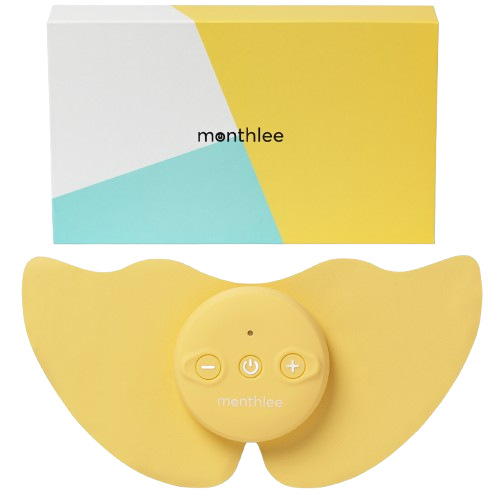
Emmeline is a small wearable TENS device. The control unit clips into the centre of our angel wings — soft wing-shaped pads that stick over the lower abdomen, where the cramping is strongest.
It runs 20 intensity levels across 6 pulse patterns, so you can find the setting your body responds to rather than accepting one preset.
It lasts 5 to 10 hours per charge, depending on the intensity you use, and recharges over USB-C in about two hours. Higher settings drain it faster — that is normal for any TENS device.
It is silent and it hides under clothing. You can put it on, get on with your day, and forget it is there.
The takeaway
You do not have to simply absorb period pain every month.
The technology to interrupt it has existed for over fifty years. It was just stuck in physiotherapy clinics and labour wards instead of in your bag.
Meet Emmeline → — 20 intensity levels, up to 10 hours of use per charge, free shipping, 60-day money-back guarantee.
keep reading
- →Period pain relief
How to help someone with period pain: what to do, what to say, and what to buy
Watching someone you love curl up with period pain and not knowing what to do is hard. Here is what the NHS suggests, what to say, what to leave unsaid, and how to know when it is time to push for a doctor.
- →TENS
Is TENS safe for period pain? Who shouldn't use it, and what to check first
For most people with ordinary period cramps, a TENS device is a low-risk option, but a few groups should not use one without medical advice. Here is who they are, where the pads must never go, and what the research says about side effects.
- →Generic TENS
Emmeline or a generic TENS unit? An honest answer to “is a period TENS just a pink tax?”
A generic TENS unit uses the same technology as a period TENS device and costs less. It also gives you more settings. Emmeline is ours, and what you pay extra for is wearability: no wires, no belt clip, and a battery that lasts a working day. Here's where each one wins, and how to set up a generic if you go that way.