Does exercise help period cramps? What the research actually found
Regular exercise lowers period pain in the trials — a Cochrane review put the average drop at about 25 points on a 100-point scale. But the benefit comes from moving across the whole month, not from forcing a run on day one. Here is what the evidence says, which kinds of exercise did best, and how to train on your period.
Short answer: yes, for most people, and by more than you might expect — but not in the way it's usually sold. A 2019 Cochrane review pooled 10 trials and 754 women and found regular exercise cut period pain by around 25 points on a 100-point scale, which the authors judged likely to be a meaningful difference (Cochrane, Armour et al. 2019). The catch: the people in those trials exercised about three times a week, all month, not just when the cramps arrived. The evidence is also low quality, mostly small studies. So: move regularly, go gently on the worst days, and don't feel you've failed if a run on day one isn't happening.
Who this is for
You're someone who trains — a few runs a week, a class, a gym habit — and every month there are one or two days where your period quietly wipes you out. You've heard "exercise helps cramps" from everyone, usually while you're curled up on the sofa, and you'd like to know whether it's true or just something people say. Fair question. Here's what the studies found.
What the Cochrane review found
Cochrane reviews pool every decent trial on a question and grade how much you can trust the result. The 2019 review on exercise and painful periods is the most cited piece of evidence on this (Cochrane, Armour et al. 2019).
- 12 trials in total, 10 of them (754 women) combined in the main analysis.
- Average reduction in pain: about 25 mm on a 100 mm scale. Think of it as roughly a 7 out of 10 becoming a 4 or 5. The authors noted that's more than twice the smallest change people actually notice.
- Both gentle and hard exercise were tested: stretching, core work and yoga on one side; Zumba and aerobic training on the other.
- The typical routine was 45–60 minutes, three or more times a week, across the whole cycle.
- The quality of the evidence was rated low to very low — small studies, results that varied between them, and it's impossible to blind someone to whether they're exercising.
That last point matters. It means the direction of the finding is consistent (exercise helps), but the exact size of the effect could be off. Honest summary: promising, not settled.
Which kind of exercise did best?
A bigger 2024 analysis compared exercise types head-to-head: 29 randomised trials and 1,808 participants with primary dysmenorrhea — the medical name for ordinary period pain (Tsai et al. 2024, Sports Medicine – Open). Pain was scored on a 10 cm line, and here's how the drop looked after four weeks:
| Type of exercise | Average pain reduction at 4 weeks (10 cm scale) |
|---|---|
| Relaxation exercise (breathing, slow stretching, yoga-style) | about 3.6 cm |
| Strength training | about 2.3 cm |
| Aerobic exercise (running, cycling, dance) | about 1.8 cm |
At eight weeks, relaxation exercise still came out top (about 3.9 cm), with mixed programmes and strength training close behind (Tsai et al. 2024). People were also less likely to drop out of the relaxation programmes, which makes sense — it's easier to stick with something that doesn't feel like punishment.
Two caveats the authors are upfront about: almost every trial (28 of 29) enrolled people aged 15–26, and most only included people with regular cycles. If you're older, or your cycle is irregular, the results may not map onto you as neatly.
What to take from it: you don't need to go hard. The gentle stuff did at least as well as the sweaty stuff, and possibly better.
Why would moving help at all?
The reviews above measure whether it helps rather than prove exactly why. The usual explanations are more blood flow to the pelvis and the body's own endorphins — reasonable, but treat them as likely rather than nailed down. What is clear is that period cramps come from the uterus contracting, driven by chemicals called prostaglandins, and that the pain is real, physical and not in your head. Moving regularly seems to turn the volume down on it for a lot of people.
So should you exercise on your period?
Here's where the research and real life part ways a bit. The trials tested exercise across the month. They mostly didn't test "go for a 10k on your heaviest day." So there's no rule that says you have to push through.
A practical way to think about it:
- Keep your normal routine through the month. That's where the evidence is strongest.
- On the bad days, swap down, don't skip out. A walk instead of a run, a stretch session instead of intervals. The NHS suggests gentle exercise like yoga, swimming, walking or cycling for period pain (NHS — Period pain).
- Listen to your body, genuinely. Rest is allowed. One missed session does not undo anything.
Can you wear Emmeline while you work out?
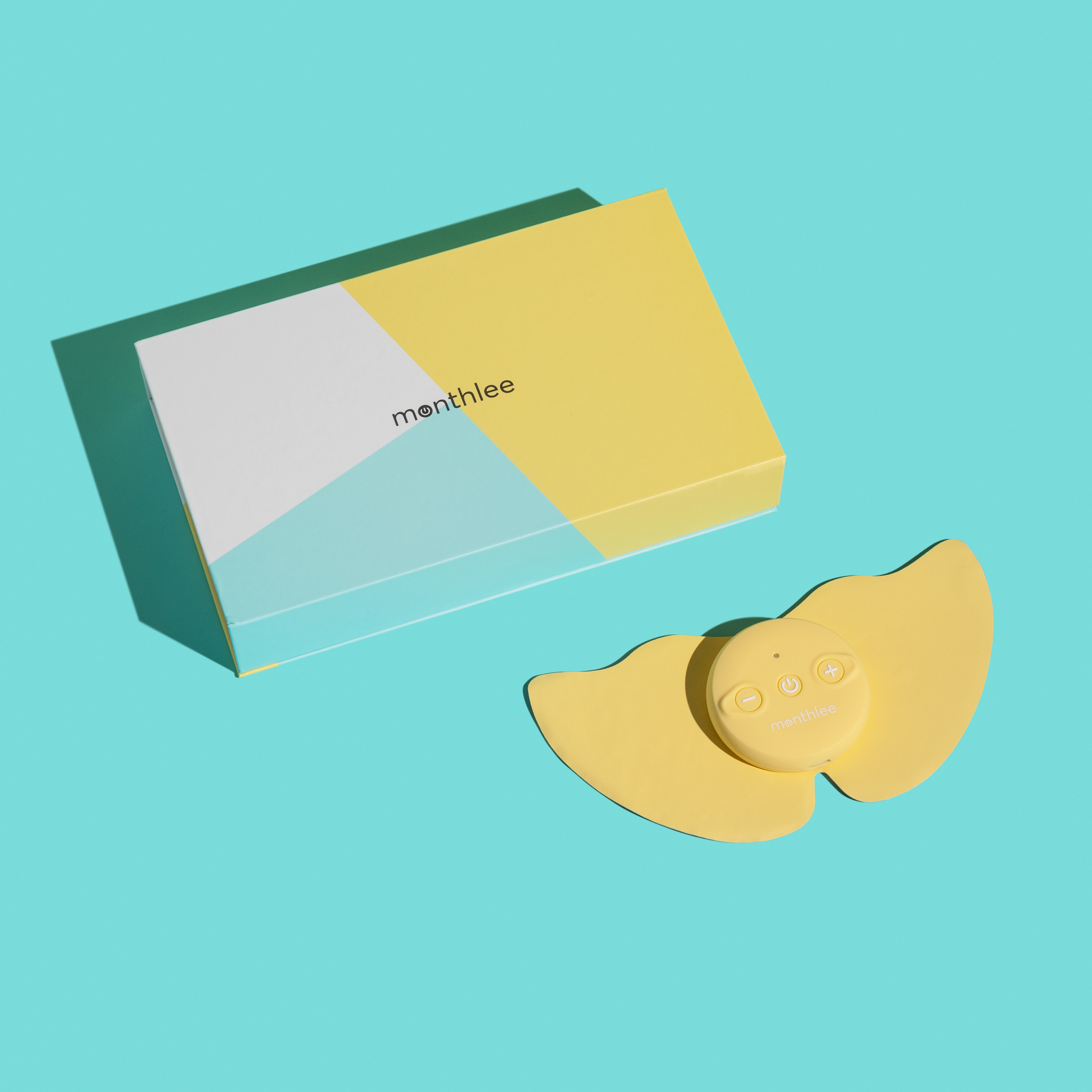
Emmeline is fully wireless — the control unit clips straight onto the pad, with no cable and nothing on your waistband — so once the angel wings are on, it sits under your clothes and moves with you. For a walk, a yoga class or a gentle stretch session, that's exactly what it's designed for.
A few honest limits, straight from the NHS guidance on TENS (NHS — TENS):
- Not in water. The NHS says don't use TENS in the bath or shower — and that rules out swimming with it on too. Take it off before the pool.
- Not while driving or operating machinery. We'd apply the same common sense to cycling on the road: a sudden change in sensation is not what you want in traffic.
- Sweat is hard on the pads. The gel on the angel wings sticks best to clean, dry skin. Heavy sweat loosens the grip and shortens how long a pad lasts — each wing is good for up to 30 uses with good care. For a hard session, you may prefer to use Emmeline before and after rather than during.
- Some people shouldn't use TENS without checking with a doctor first — including if you're pregnant, have a pacemaker, or have epilepsy (NHS — TENS).
One routine to try: Emmeline on for the walk to the gym or the warm-up stretches, off for the sweaty middle, back on for the cool-down and the journey home. TENS has been studied for period pain, and a 2024 Cochrane review found high-frequency TENS reduced it compared with placebo (Cochrane, Han et al. 2024) — how much it helps varies from person to person. Movement and TENS aren't either/or; they're two tools that don't get in each other's way.
When exercise isn't the answer
If your period pain is getting worse over time, stops you doing your usual things, or comes with heavier or irregular periods, that's a reason to see a GP or doctor rather than a reason to train harder (NHS — Period pain). Conditions like endometriosis and adenomyosis can sit behind pain that "normal" fixes don't touch — we've written about endometriosis and adenomyosis if that sounds familiar.
FAQ
Does exercise really reduce period pain? In the trials, yes. A 2019 Cochrane review found regular exercise reduced period pain by about 25 points on a 100-point scale on average, though the quality of the evidence was rated low (Cochrane).
What is the best exercise for period cramps? In a 2024 analysis of 29 trials, relaxation-style exercise — slow stretching, breathing, yoga-type work — reduced pain the most, followed by strength training and then aerobic exercise (Tsai et al. 2024).
How often do I need to exercise for it to help? The trials typically used 45–60 minutes, three or more times a week, throughout the month (Cochrane). The benefit came from regular exercise, not a single session.
Is it okay to exercise on my period? Generally, yes — the NHS lists gentle exercise among the things to try for period pain (NHS). Go by how you feel; swapping to something gentler on the worst days is completely fine.
Can I use a TENS machine while exercising? For gentle movement like walking or stretching, a wireless device such as Emmeline fits in easily. Don't use TENS in water, so not while swimming, and don't use it while driving (NHS). Heavy sweat loosens the pads, so for a hard session you may prefer to use it before and after instead.
The takeaway
Moving regularly is one of the better-evidenced, cheapest things you can do for period pain — the trials are small, but they point the same way. You don't need to go hard, you don't need to train through your worst day, and the gentle options did at least as well as the tough ones. Keep the habit going across the month, drop the intensity when you need to, and give yourself something for the days when even a walk feels like a lot.
Meet Emmeline → — $49.99, wireless, with angel wing refills from $11.99 per 2-pack.
keep reading
- →Period pain relief
How to help someone with period pain: what to do, what to say, and what to buy
Watching someone you love curl up with period pain and not knowing what to do is hard. Here is what the NHS suggests, what to say, what to leave unsaid, and how to know when it is time to push for a doctor.
- →TENS
Is TENS safe for period pain? Who shouldn't use it, and what to check first
For most people with ordinary period cramps, a TENS device is a low-risk option, but a few groups should not use one without medical advice. Here is who they are, where the pads must never go, and what the research says about side effects.
- →Generic TENS
Emmeline or a generic TENS unit? An honest answer to “is a period TENS just a pink tax?”
A generic TENS unit uses the same technology as a period TENS device and costs less. It also gives you more settings. Emmeline is ours, and what you pay extra for is wearability: no wires, no belt clip, and a battery that lasts a working day. Here's where each one wins, and how to set up a generic if you go that way.