Adenomyosis: the period pain condition nobody talks about
Adenomyosis affects around 1 in 5 women — but most people have never heard of it. If your periods are getting worse, heavier, and more painful with age, this might be why.
Endometriosis gets the awareness campaigns. Fibroids get the primetime features. But adenomyosis — which affects up to 1 in 5 women — barely gets mentioned at all.
If your period pain has been getting progressively worse over the years, if your periods are heavier than they used to be, and if you've been told everything looks normal — adenomyosis is worth knowing about.
Here's what it is, why it's missed so often, and what you can do about it.
What is adenomyosis?
Adenomyosis is a condition where the endometrial tissue that normally lines the inside of the uterus (womb) grows into the muscle wall of the uterus itself — the myometrium.
Unlike endometriosis (where tissue grows outside the uterus entirely), adenomyosis involves the uterine lining burrowing into the muscle that surrounds it. This means the muscle wall thickens and becomes inflamed with each menstrual cycle, and instead of the lining shedding normally through the cervix, it gets trapped inside the muscle — causing pain, heavy bleeding, and over time, an enlarged uterus.
It's sometimes called "internal endometriosis" in older literature, though the two conditions are distinct — they can co-exist, but one doesn't cause the other.
Who gets adenomyosis?
Adenomyosis is most commonly diagnosed in women in their 30s and 40s, typically after at least one pregnancy — though it can occur in younger women and those who haven't been pregnant. The reason it's associated with older age is partly biological (the condition typically worsens over time) and partly diagnostic (it's been chronically underdiagnosed in younger women).
It often coexists with:
- Endometriosis (~20% of cases)
- Fibroids (uterine fibroids are common alongside adenomyosis)
- PCOS
Menopause typically brings significant improvement, since adenomyosis is driven by oestrogen — without the hormonal cycle, the condition regresses.
Symptoms: what adenomyosis actually feels like
Progressively worsening period pain This is the hallmark. Unlike primary dysmenorrhea (which tends to stay stable or improve with age), adenomyosis pain typically gets worse over the years. Women with adenomyosis often describe periods that they "used to be able to manage" becoming increasingly debilitating.
Heavy or prolonged periods Heavy menstrual bleeding — soaking through protection every 1–2 hours, passing large clots, or bleeding for more than 7 days — is very common with adenomyosis. The enlarged, disrupted uterine muscle can't contract effectively to slow bleeding.
An enlarged or tender uterus Many women with adenomyosis have a uterus that feels bulky or tender on examination. A GP or OB-GYN may note this during a pelvic exam.
Pelvic heaviness or pressure A feeling of weight or pressure in the lower pelvis, especially in the days before and during a period.
Pain that radiates to the thighs and lower back Cramping that travels — particularly down the thighs — is more associated with adenomyosis than typical primary dysmenorrhea.
Bloating before and during your period Disproportionate bloating in the days leading up to your period ("period bloat" or the "period belly") is a frequently reported symptom.
Pain during sex Particularly deep penetration — caused by pressure on an inflamed, enlarged uterus.
Why is it so often missed?
Several reasons — and again, none of them reflect well on the state of women's healthcare:
It was invisible on ultrasound for years. Traditional ultrasound has limited sensitivity for adenomyosis. MRI is more accurate but expensive and not typically the first-line investigation. This led to decades of missed diagnoses, with women being told their scans were "normal."
The definitive historical diagnosis required a hysterectomy. The gold standard used to be histological examination of the uterus after removal. Obviously this wasn't a practical diagnostic tool for most women. Advances in high-resolution transvaginal ultrasound and MRI now allow adenomyosis to be diagnosed non-invasively — but the culture of dismissal persisted long after the imaging improved.
Symptoms overlap significantly with fibroids, endometriosis, and normal menstruation. Without careful questioning, the progressive nature of adenomyosis symptoms can be missed.
Women's accounts of their own pain history are often discounted. A woman reporting that her periods are "getting worse every year" should prompt investigation. Too often, it prompts reassurance.
Getting a diagnosis
See your GP (UK) or OB-GYN (US) and be specific:
- "My periods have been getting progressively heavier and more painful over the last [X] years."
- "I'm soaking through [pads/tampons] every [time period]."
- "The pain is rated [X]/10 on my worst days."
- "I'd like to specifically rule out adenomyosis and fibroids."
Request a transvaginal ultrasound. An experienced sonographer looking specifically for adenomyosis can identify characteristic features — but you may need to ask explicitly. An ultrasound reported as "normal" by someone not specifically looking for adenomyosis may not be definitive.
Ask about MRI if ultrasound is inconclusive. Pelvic MRI has around 85% sensitivity for adenomyosis — significantly better than standard ultrasound. In the UK, this typically requires a gynaecologist referral. In the US, your OB-GYN can order it directly.
Treatment options
There's no cure for adenomyosis short of hysterectomy (which ends the cycle entirely). But there are effective management options:
Hormonal treatment
- The Mirena IUD (levonorgestrel-releasing IUS in the UK) is one of the most effective medical treatments for adenomyosis — it reduces menstrual bleeding by up to 90% and significantly reduces pain. It's often the first-line recommendation for women who want to preserve their uterus.
- Combined oral contraceptive pill — useful for cycle regulation and pain reduction, though less effective for severe adenomyosis than the Mirena.
- GnRH agonists (goserelin in the UK; Lupron in the US) — induce a temporary menopause, highly effective for symptoms, but side effects (hot flushes, bone density) limit long-term use. Sometimes used as a bridge before surgery.
Pain management
- NSAIDs (ibuprofen, naproxen) taken before pain peaks
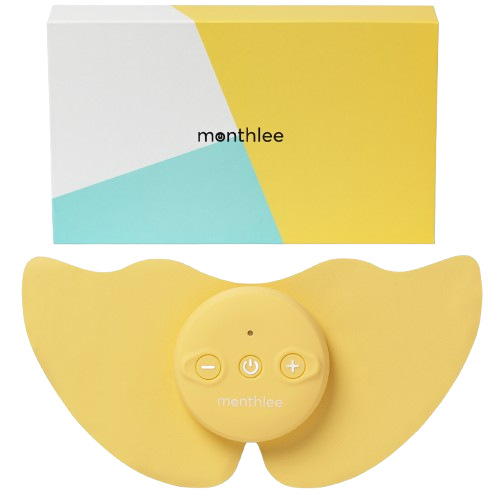
- TENS therapy — many women with adenomyosis find wearable TENS consistently effective for managing cramping, particularly when the pain comes in waves
- Heat — sustained heat on the lower abdomen and lower back
- Magnesium supplementation in the week before your period
Surgery
- Uterine artery embolisation — cuts blood supply to the adenomyosis deposits; less evidence than for fibroids but used in some centres
- Hysterectomy — definitive treatment; eliminates adenomyosis entirely. Only discussed when symptoms are severe, other treatments have failed, and fertility is not a goal.
You don't have to wait for a diagnosis to manage the pain
If you recognise these symptoms and are waiting for investigation — or just trying to get through each month — the same evidence-based approaches apply. Adenomyosis pain responds to the same tools as severe dysmenorrhea, even while the underlying cause is being investigated.
Drug-free, immediate relief starts with TENS. Wearable TENS therapy works by interrupting the pain signal from your uterus to your brain — it's effective for the type of severe cramping adenomyosis causes, and you can use it for as many hours as you need.
Start managing symptoms now
Emmeline is a wearable TENS device for period pain — including the severe cramping associated with adenomyosis. Drug-free, works in minutes, silent under clothing.
Meet Emmeline → — 20 intensity levels, up to 10 hours battery, 60-day money-back guarantee. Free shipping to the US and UK.
keep reading
- →Period cramp simulator
Period cramp simulators: what the machine actually does
You've seen the videos. A man gets wired up, lasts eleven seconds, and apologises to everyone he's ever met. Here's what the machine really is, what it proves, and what it can't.
- →Endometriosis
Endometriosis must-haves: 11 things that help on the worst days
Endometriosis has no cure. But some things make a bad day shorter and a hard week easier. Here are 11 that earn their place, and two that do not.
- →Period pain
Why are my period cramps so bad? 6 reasons (and what actually helps)
Severe period pain isn't something you should just push through. Here are six medical reasons your cramps might be worse than usual — and what you can actually do about them.