How to manage period pain at work or school (without anyone knowing)
The average person loses 9 working days a year to period pain. It doesn't have to be that way. Here's how to get through day 1 and 2 without losing your mind — or your productivity.
Let's be honest about what day 1 of a bad period looks like.
You wake up, already in pain. You lie there calculating whether you can actually make it in. You drag yourself up, spend the commute trying not to look like you're in agony, sit at your desk unable to concentrate, pop ibuprofen on repeat, and spend most of your energy just performing being fine.
The average person who menstruates loses 9 working or school days a year to period pain. That's not sustainable. And it doesn't have to be the norm.
Here's the actual playbook for managing period pain at work or school — including the things that work discreetly, the things to prep in advance, and how to talk about it if you need to.
The night before: prep makes day 1 survivable
The difference between a manageable pain day and a write-off is almost always preparation. If you track your cycle (even roughly), you know when day 1 is coming. Use the night before.
Start NSAIDs before the pain starts. Ibuprofen (Advil, Nurofen) and naproxen work by blocking the prostaglandins that cause cramping. If you wait until you're already in pain, you're playing catch-up. Take the first dose the evening before your period is due, with food. For many people, this single change makes the following day dramatically more manageable.
Charge your TENS device. If you own a wearable TENS device, make sure it's charged and ready to go. You'll want to put it on before you leave the house — not fumble with it at your desk while already in pain.
Pack your period kit. Medication. TENS device. Heat patches if you use them. Spare pads or tampons (or whatever you use). A snack. The goal is to not need anything you don't have.
Get to bed early. Sleep is anti-inflammatory and genuinely helps. You'll cope better with pain on a good night's sleep than a bad one.
At work: the tools that work discreetly
Wearable TENS
A wearable TENS device is the single best tool for managing period pain at work or school. Here's why:
- You stick it on under your clothing, and nobody knows it's there
- It's completely silent
- It works in minutes
- You can adjust the intensity discreetly without taking anything out of your bag
- There are no drugs involved — no drowsiness, no stomach upset, no interactions
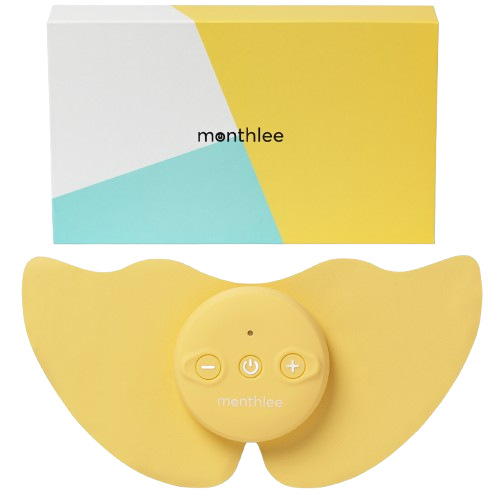
TENS devices like Emmeline were specifically designed for this. The angel wings stick over your lower abdomen, the controller clips in, and you go about your day. They run for up to 10 hours on a charge — enough to get you through a full work day.
Stick-on heat patches
Disposable heat patches (like ThermaCare in the US, or similar products available at UK pharmacies) are discreet, thin enough to wear under clothes, and provide continuous low-level heat for 8–12 hours. They're not as powerful as a hot water bottle, but for work use, they're a game-changer.
Some people combine TENS and a heat patch for a particularly heavy pain day.
Strategic ibuprofen timing
If you're going to take ibuprofen, take it before pain peaks — ideally with a meal. The goal is to stay ahead of the prostaglandin wave, not chase it. Dosing: 400mg every 6–8 hours, maximum 1200mg per day (UK/US standard dose — follow the packet).
Naproxen (Aleve in the US, or prescribed in the UK) lasts longer (around 8–12 hours) and is worth asking your GP or pharmacist about if ibuprofen doesn't last long enough.
Stay warm
Cold makes cramping worse. If your workplace or school is air-conditioned, bring a layer. A warm drink (ginger tea, or just hot water with lemon) also helps — ginger has genuine evidence behind it for reducing prostaglandin production.
Managing concentration when you're in pain
Pain is cognitively demanding. When your body is fighting cramps, there's genuinely less bandwidth for focus. Here's how to work with that:
Do the hard cognitive work first. If you have any choice about your schedule, front-load the tasks that require focus to the morning, before pain typically peaks. Save emails, admin, and lower-stakes tasks for the afternoon.
Use the Pomodoro technique. 25 minutes of focused work, 5 minutes of rest. Short sprints are easier to commit to than trying to maintain concentration for hours.
Eat something small and regular. Blood sugar crashes make pain worse. Avoid sugar spikes and crashes — protein-based snacks (nuts, eggs, hummus) are better than biscuits and crisps on pain days.
Hydrate more than usual. Dehydration worsens cramping. Keep water at your desk and drink consistently throughout the day.
Move gently every hour. Even a 5-minute walk improves pelvic blood flow and provides a brief endorphin boost. If you're in school and can't leave, standing and moving at your desk helps.
If you need to talk to your employer or teacher
You shouldn't have to explain yourself. But if you need to ask for accommodations — to work from home, take a longer lunch, or leave early — here's how to approach it.
In the UK: Since 2023, there has been increasing pressure on employers to develop menstrual health policies. Some forward-thinking companies now offer additional flexibility during menstruation. You can also self-certify for up to 7 days of sick leave without a GP note — period pain is a valid reason to use it. You don't have to be specific about the reason.
In the US: Period pain isn't explicitly covered by the ADA, but if you have a diagnosed condition (endometriosis, adenomyosis, PCOS) that causes severe symptoms, you may have grounds for reasonable accommodations under the ADA. HR can walk you through your options.
For students (UK and US): Talk to your student welfare officer, school nurse, or a trusted teacher. Many schools will allow you to sit exams with breaks, rest in a quiet space, or have extensions on deadlines. You need to ask — most schools want to support you but won't offer unless you flag it.
Building a period-proof routine
The long game is cycle awareness. When you know your pattern, you can plan around it:
- Don't schedule your hardest obligations on day 1 and 2 if you have any flexibility
- Track your cycle with any period app (Clue, Flo, Natural Cycles) — even 2 months of data gives you predictive power
- Build in recovery. A lighter evening on day 1 helps you show up better on day 2
- Keep a period kit at work. Don't rely on memory when you're in pain
The bottom line
Period pain at work or school is not something you should just push through unaided. You have options — and using them isn't making a big deal of it. It's just being practical about a real physical experience that happens every month.
The people who manage it best are the ones who prep the night before, use TENS on heavy days, front-load NSAIDs, and don't try to white-knuckle through 8 hours without support.
The tool most women at work swear by
Emmeline was built for exactly this. A silent, wireless TENS device that lives under your clothes and gets to work in minutes. Put her on before you leave the house. Forget she's there. Get on with your day.
Shop Emmeline → — drug-free, discreet, up to 10 hours battery. Free shipping. 60-day money-back guarantee.
keep reading
- →TENS
How long can you use a TENS machine for period pain? (And the settings that actually matter)
There is no daily dose limit on a TENS machine the way there is with painkillers. Here is how long a session should run, how often you can use it across your period, whether you can leave it on all day, and the two settings that decide whether it works.
- →Endometriosis
Does TENS actually help endometriosis pain? What a new 2026 study found
A new pre-post study out of Penn State followed 27 women with surgically confirmed endometriosis using a TENS unit for three months. The headline pain score didn't move enough to call it a win — but quality of life and pain-medication use both did, significantly. Here's what the study actually measured, what it didn't, and how it's different from the stronger evidence behind TENS for ordinary period pain.
- →TENS machine
Do heated TENS devices work better for period pain? What the ratings actually show
Some TENS devices for period pain now come with built-in heat, and on paper that sounds like a straightforward upgrade. We compared the public star ratings across every period-specific wearable TENS device we could find on Amazon and found the opposite pattern: heated hybrids rate lower than plain TENS, not higher. Here's the pattern, the likely reason for it, and how to decide which type is actually right for you.